‘A spark of hope’: 25 years after 9/11, the Daffodil Project keeps blooming
‘A spark of hope’: 25 years after 9/11, the Daffodil Project keeps blooming
By Kirstyn Brendlen
September 9, 2026
Days after 9/11, when the city was still reeling, public garden designer Lynden Miller got a message from one of her longtime colleagues, Dutch floral supplier Hans van Waardenberg.
“He said, ‘We’re so distressed in the Netherlands about what’s happened to New York. New York used to be New Amsterdam back in the 1600s, we so wish there was something we could do to help you,’” Miller recalled.
Miller had an idea, and asked if van Waardenberg had any extra flower bulbs lying around.
Van Waardenberg had first offered tulips, Miller said, but she turned him down. Squirrels eat tulip bulbs, she said, and the blooms don’t always return after the first year. She asked for daffodils instead. Yellow is the color of remembrance, Miller said, and daffodils are hardy flowers that return year after year.
A few weeks later, when New York Harbor reopened, a ship sailed in laden with a million daffodil bulbs gifted by van Waardenberg and the City of Rotterdam.
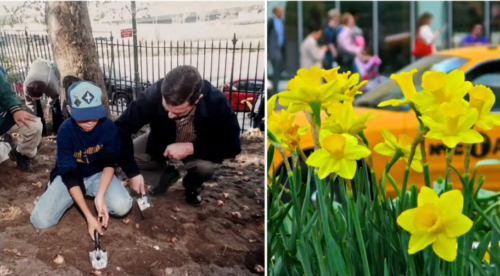
Advocacy group New Yorkers for Parks, the city’s parks department and then-Manhattan Borough Park Commissioner Adrian Benepe recruited volunteers to plant the bulbs in honor of the nearly 3,000 people who died in the attacks on the World Trade Center, and The Daffodil Project was born.
Miller said she felt New Yorkers needed something to do in the aftermath of the tragedy — a distraction or a way to feel helpful. She recalled a father who signed up the first year to plant bulbs in memory of his son, a police officer, who had died on 9/11.
“Of course, we all needed that,” she said. “When people heard that there were these daffodils and they need to get in the ground, people showed up from all over the place.”
The flowers went all over the place, too.
“I said … I don’t want these bulbs to go where there have already been bulbs, like Bryant Park, or Central Park or something,” Miller said. “I want them to go in all five boroughs that haven’t seen a flower in years. And that’s what we did. We put them in Queens along Jamaica Bay, and East New York, put them in East Harlem and the Bronx. Well, we put them everywhere we could.”
Come spring, the city was awash in yellow flowers. From the Circle Line ferry cruise, Miller said, they were visible over the waterfront.
The Daffodil Project keeps blooming, 25 years later
Twenty-five years later, New Yorkers for Parks has planted more than 10 million daffodil bulbs across the five boroughs. Every fall, the organization distributes bulbs to community groups and locals, who plant them in parks, tree beds, front yards, even on road medians and in grassy strips on the edges of parking lots.
“Of course, the foundation of the project is still a living memorial for those who were lost on 9/11,” said Adam Ganser, executive director of New Yorkers for Parks. “But over the years, so many other layers have been added to what this project means for people. Not the least of which is because there are many, many New Yorkers here now that weren’t here for 9/11, so planting these bulbs has additional meaning for them.”
Planting the bulbs has become something of a community project, he said. All across the city, locals pick up bulbs to plant with their families and neighbors. But the project retains much of its original meaning.
“As for folks that have been doing it from the beginning, and particularly folks who have lost friends and family on 9/11, it is remarkable how meaningful this is for them,” Ganser said. “Often, they’re getting together with people who experience the same thing. You know, it’s now an annual ritual for them, seeing the daffodils bloom in the spring, of course, is is a you know moment of joy.”
Nuala O’Doherty Naranjo has been taking part in the Daffodil Project for many years in honor of her sister-in-law, Marni Pont O’Doherty, who was killed on 9/11.
Marni “had a real sparkle,” Nuala recalled, and was a fastidious planner who always had people’s birthday gifts purchased and ready to go months in advance.
“You know, when she got married, there was a binder about that,” Nuala said. “She’s the kind of person who got married, paid for her own wedding, and bought a car the same year. She had it all saved up, it was all planned, to the point of scientifically picking what weekend her wedding should be based on fall foliage and likelihood of rain.”
Marni and her husband Joe — Nuala’s brother — had just purchased a house, and Marni had recently gotten a “fabulous” job at Keefe, Bruyette & Woods, Nuala said. On a ferry ride around Manhattan in August 2001, she recalled Marni pointing out her office near the top of the South Tower.
“So when the first tower fell, [Marni] did what most people did, she called her mom,” Nuala said. “She said, ‘Mom, I’m okay. It was the other tower.’ And then she sat and chatted to her mom until the plane hit her tower, and her mom never forgave herself and died shortly thereafter. She’s like, ‘Why didn’t I tell her to get out?’”
Marni was the youngest of three siblings, threw herself into hobbies and activities, and loved to research different topics and email her family and friends about it, her family told the New York Times in 2001. She was also a massive Rick Springfield fan whose many contributions to a Springfield email list have been preserved online. In her introductory email, Marni, asked how she pictured herself in 2005, said she would like to have a house, two kids, and a couple of dogs.
“It’s so sad because she had this great plan for the future, and and of course, none of it got to come true,” Nuala said.
Marni’s death devastated her family. They planted a tree at her alma mater, Bayside High School, in her honor, and Nuala later got involved in the Daffodil Project and started planting the bulbs in Marni’s honor every year.
Now, Nuala is a co-founder of the 34th Avenue Open Streets Coalition in Queens. The open street is 26 blocks long, with a median down the middle and “endless” places for daffodil bulbs, Nuala said.
It’s also a distribution site, where participants come to get their allotted bulbs, and Nuala gets to talk a little bit about Marni every year.
“It’s wonderful,” to speak about her, Nuala said, and “sets a positive tone.”
“To say, you know, whenever I see a daffodil, I think about her, and I get to spread that joy when we plant them, and to say ‘This is in memory of Marni,’” she said. “And to say, ‘This is a life we lost that can bloom on together.’”
The blooms take on new meaning
Over time, the project has taken on new layers of meaning for Nuala. She also works at an immigrant center in Queens that hosts a weekend gardening program. Planting flowers in the neighborhood, she said, helps recently-arrived immigrants set down literal roots. Many of the participants come from farming backgrounds, she said, and planting something in New York helps to make it feel like home.
“In these kind of dark times of immigration, it’s a little spark of hope that [they’re] going to be here in the spring to watch this flower bloom,” she said.
Since 2001, the daffodil has become a symbol for New Yorkers for Parks, Miller said, and the project has turned into a way to inspire civic engagement among New Yorkers.
“The flowers are really a vehicle for people to get together,” Ganser said. “They’re a way for people to spend time together, but also it’s become a way for people to galvanize around the need for more and better parks and open space in New York City.”
The organization now distributes native plant seeds as well as daffodil bulbs. In recent years, adding native plants to New York City has become an “absolute priority,” Ganser explained, and they felt giving the seeds out would help engage younger participants and bring the project to a new audience.
“We felt like using the native seeds was a way to kind of engage a new audience and add to the narrative of the project, and that has been tremendously successful,” he said. “People love getting them.”
In 2021, the organization decided to honor victims of the COVID-19 pandemic as well as the victims of 9/11. Tens of thousands of people died from the virus in New York City, and lockdowns highlighted just how important open spaces were, Ganser said, especially in neighborhoods where green space is scarce and people had few options during lockdowns.
“It just seemed completely appropriate to give voice to that tragedy,” he said. “But, again, through joy and community participation, getting out and getting your hands dirty. I think it was very much appreciated by New Yorkers who were all going through that crisis at the same time, obviously, and and and really kind of brought a shared spirit to the effort that was really kind of beautiful.”